
History
The Royal Sanctuary of Nuestra Señora de las Nieves is the Christian centre and spiritual heart of the island of La Palma, a place of pilgrimage and reunion for all the people of La Palma over the centuries, under the protection of the Patron Saint of La Palma.
For more than five centuries of history it has been the Mansion of the Virgin, guarding within its walls the sacred and cultural heritage of the island, the result of the filial offerings of love to the Mother of all the people of La Palma.
HISTORICAL CHRONOGRAM:
15TH CENTURY
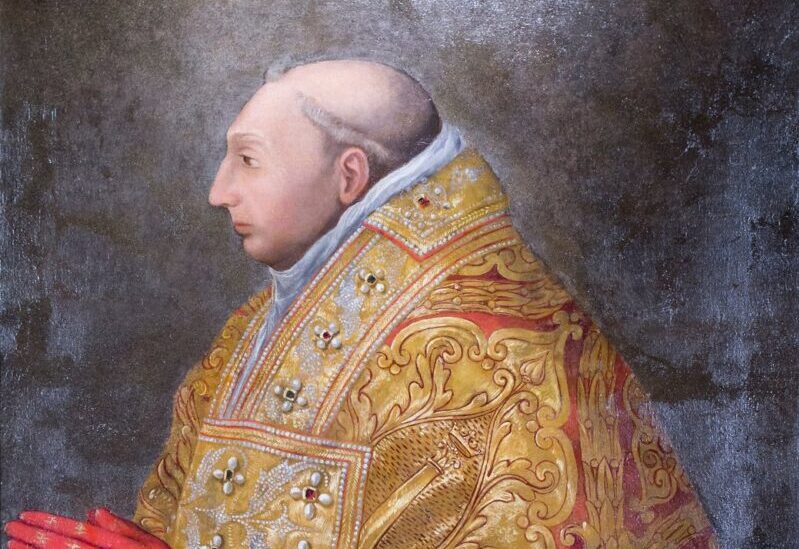
1424
Viera y Clavijo records in the 18th century that there was already a small Sanctuary well before the Conquest of the Canary Islands, as there is a Bull of Martino V that mentions a chapel under the title of ‘Santa María de La Palma’ in all the islands.
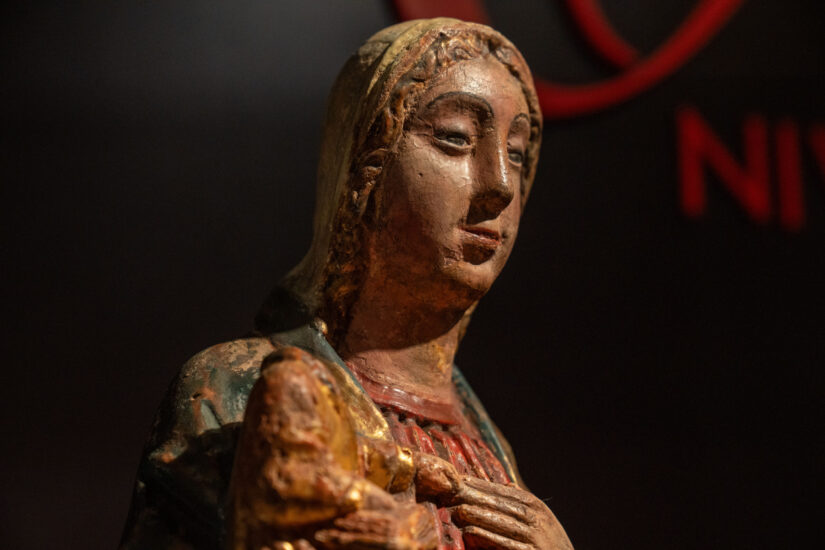
1460-1468
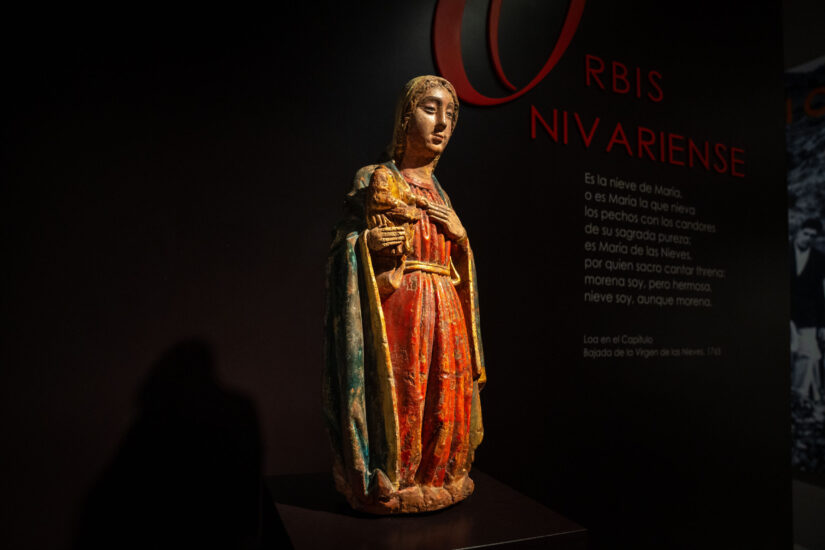
Attributed to the sculptor Lorenzo Mercadante de Bretaña, the carving of the Virgen de las Nieves may have been made around the same time as this sculptor was working in Seville. The Virgin is a carving from the late Gothic period, modelled in polychrome terracotta. According to tradition, the Virgin was already being worshipped by the ancient aborigines in a cave near the present Sanctuary.

1492
Alonso Fernández de Lugo begins the conquest of La Palma, arriving at the coast of Tazacorte on 29th September.

1493
The conquest of the island ends on 3rd May with the foundation of Santa Cruz de La Palma in the bay of Cantón de Tedote.
16TH CENTURY

1507
Date of the oldest surviving document naming the place and the Virgin as ‘Santa María de las Nieves’ (23rd January 1507), it is a Data from the Adelantado Don Alonso Fernández de Lugo, donating to the Virgin the land on which in 1517 the primitive temple was already built.

1525
The primitive church is rebuilt and a wooden and tile roof, a bell tower, a carved stone main doorway and a side doorway are installed.
1531
The Day of the Virgin was already celebrated with great solemnity.

1534
First time that an article of clothing belonging to the Virgin appears in the inventory of 12th July: ‘an old silk headdress’.

1571
Cloaks and headdresses for the Virgin’s clothing and a silver crown already appear in the inventory.

1574
Votive Lamp, donated by the Vandale family, made of silver from the Antwerp workshops.
17TH CENTURY

1639
The oldest sailor ex-voto preserved in the Sanctuary and the second oldest in Spain.

1646
The first miracle during the eruption of the volcano of San Martín is attributed to her. The Virgin was went down to the city in rogation and the volcano was extinguished and the peaks were covered in snow.

1648
The church is remodelled again, enlarging the main arch and the main chapel.

1649
Felipe IV takes the Sanctuary under his Royal Patronage, from then on it is called the Royal Sanctuary.

1649
The Dominican Order attempts to found a convent in the Sanctuary, the people and the secular clergy were against it, finally they were expelled the following year.

1657
The Parish is created in the Sanctuary, placing the Blessed Sacrament in a solemn ceremony in February 1658.

1661
Fifteen loads of ‘small stone’ from the ravine were used to make the traditional paving of the square in front of the Sanctuary of Las Nieves.

1664
After several alterations to the primitive hermitage, the orientation of the temple was changed and the length of the current sanctuary was decided. The stone arch in the sacristy, is part of the old hermitage.

1664
The expenses for the construction of the current Casa de Romeros, which replaces an earlier one from 1571, appear in the inventories.
1667
It is used for firs time, the marble baptismal font, that was brought from Seville.
1672
The sacristy and parts of the church are rebuilt and extended.

1676
While Bishop García Ximénez was on the island, it coincided with a great drought. On being informed of the great devotion that the people of La Palma had for the Virgen de las Nieves, especially in times of misfortune, he ordered that the image should be gone down to the church of El Salvador in rogation, deciding that this procession would be repeated every five years from 1680 onwards. This is the founding motif of the current ‘Bajada de la Virgen’ (Descent of the Virgin).
1680
First edition of the Festas Lustrales de la Bajada de la Virgen de las Nieves, from the Sanctuary of El Monte to the Parroquia Matriz de El Salvador.
1681
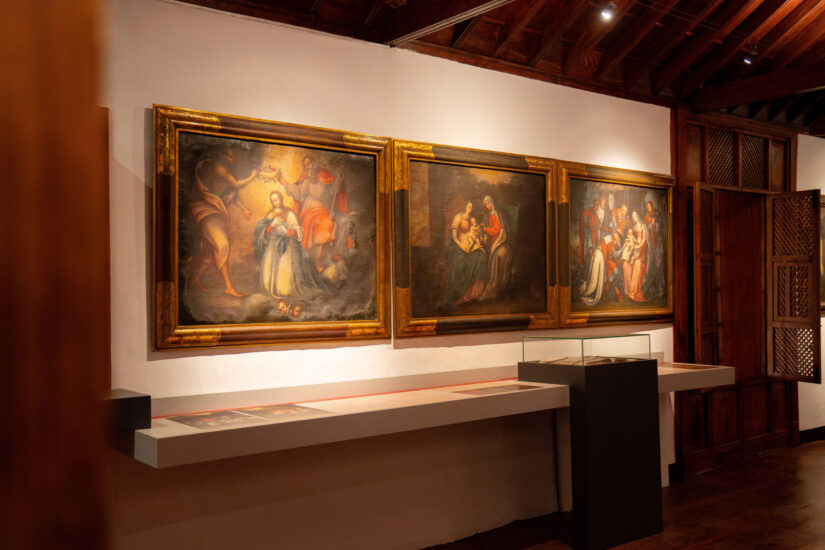
The Esclavitud de Nuestra Señora de las Nieves is founded by Juan Pinto de Guisla.

1683
Dating of the baldachin canopy, made of silver embossed with Baroque motifs, which the Virgin of the Snows carries.

1684
The Slaves’ Room is built above the Sacristy; and the Virgin’s Dressing Room, located behind the niche of the Virgin, in the High Altar.

End of 17th century
First performances of one of the oldest and most traditional acts of the Bajada de la Virgen de las Nieves: El Carro Alegórico y Triunfal (The Allegorical and Triumphal Chariot), a Marian play that inherits the forms and dramaturgy of the Autos Sacramentales of the Baroque period, with the theme dedicated to the Virgin.
18TH CENTURY

1701-1708
The current main altarpiece of the Sanctuary is built, designed by the painter and sculptor Bernardo Manuel de Silva, the design of which was followed by the master carpenter Marcos Hernández Duarte.

1706
Construction of the Rectory-House, replacing an older one.

1713-1714
The construction of the festive Altar-Throne of the Virgen de las Nieves, made of embossed silver, is completed.

1720
The Traveling Chair is brought into use. Its four crystals, sent from Paris, were donated by the Marquis of San Andrés, engraving his heraldic coat of arms on them. It was used until the Bajada of 1970.

1735
There is evidence that the hull of a boat was already built in the Barranco de Las Nieves ravine for the representation of the Dialogue of the Castle and the Ship, one of the most traditional acts of the Bajada de la Virgen.
1740
Construction of the current main arch of the main chapel.

1757
Calvario del Amparo and Ntra. Sra. del Buen Viaje altarpieces-horn window.
19TH CENTURY

1860
Although the Pandorga was already celebrated outside the Lustral Festivities in the 17th century, the first references to the Pandorga within the festivities take place in 1860.

1885
Although, there is evidence of the performance of the first Dialogues between the ship and the castle in the 18th century, the act as we know it today, has been performed since 1885 with the original text by Antonio Rodríguez López.

End of the 19th century
The decoration of the Chapel Vault and the High Altar by the famous painter Ubaldo Bordanova Moreno (1866-1909) begins.
20TH CENTURY

1905
The ‘magical’ transformation begins in the Danza de los Enanos, one of the main events of the Bajada de la Virgen de las Nieves.

1925
The performance of the Escenificación de la Conquista de la Isla, one of the most moving acts in the return of the Virgin to her Sanctuary in the Bajadas Lustrales, begins. It is a work by José Felipe Hidalgo.

1930
Canonical Coronation of Our Lady de las Nieves by Pontifical Bull of Pope Pius XI. It was on June 22nd in a solemn ceremony officiated by Cardinal Federico Tedeschini, nuncio of His Holiness in Spain and archbishop of Lepanto.

1942
Appointment of the Virgen de las Nieves as Honorary and Perpetual Mayoress of Santa Cruz de La Palma, ratified by the Town Council in 2018.

1945
In the 1945 edition of the Bajada de la Virgen, the so-called Festival del siglo XVIII, known as Minué, began to be performed. It succeeded one of the most traditional numbers of the lustral programme until then: the children’s choreographed dances.

1952
Declaration of the Immemorial Patronage of the Virgen de las Nieves and San Miguel Arcángel over the whole island of La Palma by Pope Pius XII by Pontifical Brief of 13th November.

1960
Construction of the altarpieces of San Miguel Arcángel and Ntra. Sra. de los Ángeles.

1964
Appointment of the Virgen de las Nieves as Honorary and Perpetual Mayoress of Los Llanos de Aridane, ratified by the Town Council in 2019.

1964-1965
The image of Las Nieves toured the whole island of La Palma and all its parishes for the construction of the Nivariense Diocesan Seminary and in communion and solidarity with the Diocese. It was the first and only time that the image has visited all the villages of the island.

1971
The Feast of the Mothers is instituted in the Sanctuary on the last Sunday of the month of May.

1975
The Virgin unveils the new Travel Chair, designed by Pedro Daranas Roque and gilded by César Fernández Molina. It was designed by Alberto J. Fernández García with reminiscences of the previous chair.

1976
A replica of the Virgen de las Nieves is taken to Cagua (Venezuela) by five immigrants from the island of La Palma. Every 5th of August, Palmeros and Canary Islanders from all over Venezuela gather around her.

1977
The construction of the museum building next to the Sanctuary begins.

1977
Their Majesties King Juan Carlos I and Queen Sofia of Spain visit the Royal Sanctuary (15th October), where they present Her Majesty the Queen with the title of ‘Camarera de Honor de la Santísima Virgen de las Nieves’, which she had accepted as Princess of Spain, as well as ratifying the title of ‘Real’ (Royal) to the Sanctuary.

1980
The Custodians of Our Lady of Las Nieves are founded, with the aim of safeguarding and guarding everything related to the devotion to the Virgin of Las Nieves.

1982
The Virgen de las Nieves is named Honorary and Perpetual Mayoress of Fuencaliente de La Palma.

1992
Appointment of the Virgen de las Nieves as Honorary and Perpetual Mayoress of Breña Baja.

1993
The image of Las Nieves is brought down to Santa Cruz de La Palma outside the five-year period for the commemoration of the 5th Centenary of the Foundation of the City.

1993
The Camarín de la Virgen is enlarged and rebuilt, the origin of the Museo Sacro Virgen de las Nieves (Virgin of Las Nieves Sacred Museum).

1994
The Virgin of Las Nieves is named Honorary and Perpetual Mayoress of Breña Alta.
21ST CENTURY

2004
Appointment of the Virgen de las Nieves as Honorary and Perpetual Mayoress of Puntallana.

2005
Appointment of the Virgen de las Nieves as Honorary and Perpetual Mayoress of San Andrés y Sauces, Villa de Mazo and Tijarafe.

2010
Appointment of the Virgen de las Nieves as Honorary and Perpetual Mayoress of Barlovento, Garafía, El Paso, Puntagorda and Tazacorte.

2011
On 14th January it was unanimously agreed, by all the political forces, to award the Gold Medal of La Palma to the Royal Sanctuary, in recognition of its spiritual, cultural and aesthetic transcendence and its character of integrating the feelings of identity of the people of La Palma.

2011
On 11th February it was unanimously agreed, by all political forces, to appoint Our Lady of Las Nieves as Mayor of the Island of La Palma, handing her the baton of command on 5th August 2020.

2019
Since 2019 she is Honorary and Perpetual Mayoress of the fourteen municipalities of the island of La Palma.

2020
The bishop of the Diocese Nivariense, D. Bernardo Álvarez, suspends the Bajada de la Virgen de las Nieves, due to the health crisis caused by the coronavirus (COVID 19).

2025
God willing the Virgin will come down again in July 2025 after ten years without visiting Santa Cruz de La Palma.